> For the complete documentation index, see [llms.txt](https://black-horizon-studios.gitbook.io/emerald-ai-wiki/llms.txt). Markdown versions of documentation pages are available by appending `.md` to page URLs; this page is available as [Markdown](https://black-horizon-studios.gitbook.io/emerald-ai-wiki/emerald-components-required/detection-component/setting-up-the-detection-layers-and-player-tag.md).
# Setting up the Detection Layers and Player Tag
## Setting up the Detection Layers and Player Tag
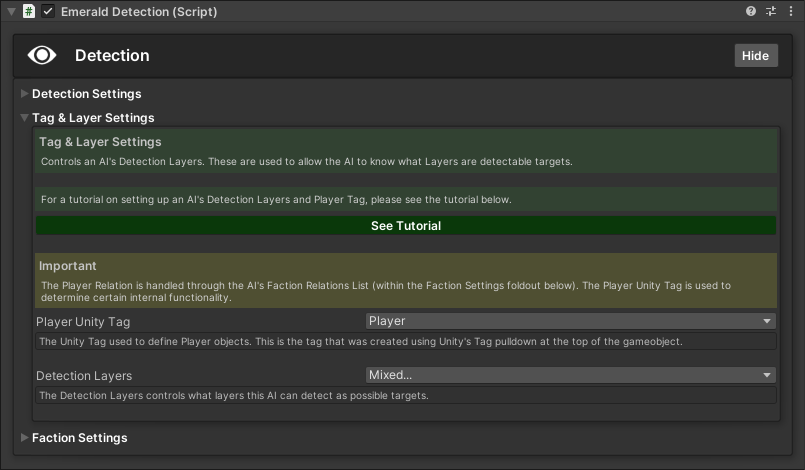
The Tag and Layer Settings controls an AI's Detection Layers and Player Tag. These are used to allow the AI to know what Layers are detectable targets as well as what targets are players.
To set up your Player Tag, assign your player object's Unity Tag (the tag that was assigned using Unity's Tag pulldown at the top of the gameobject).
{% hint style="warning" %}
**Important:** Ensure the Player Tag is set up correctly as skipping this step or applying the incorrect tag will result in AI being unable to detect player targets properly. This step is also important for allowing AI to use the Look At feature which allows AI to look at player targets while wandering, given they have a Friendly Relation Type.
{% endhint %}
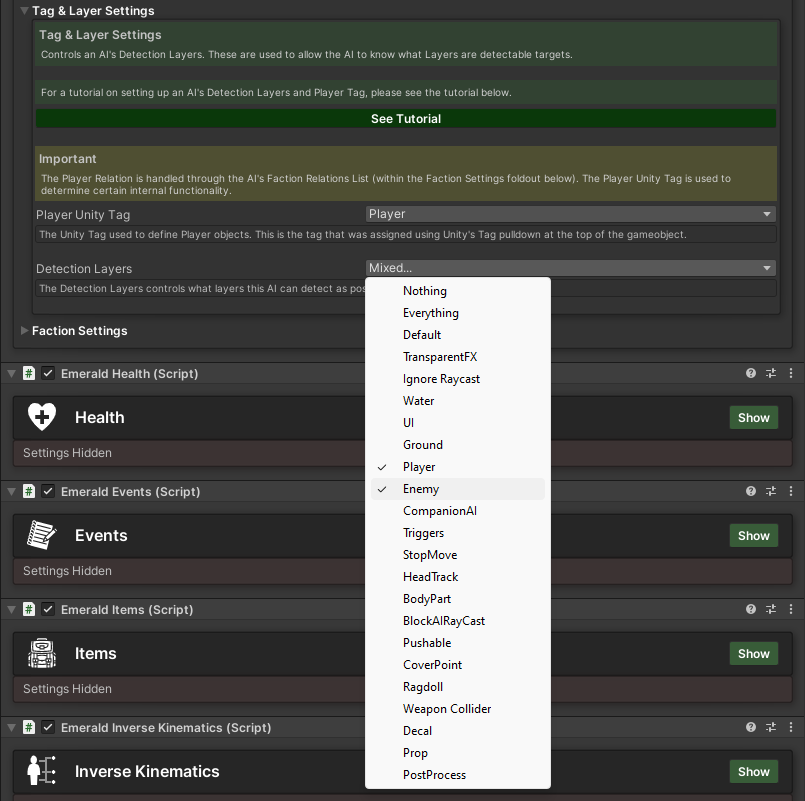
To assign layers to the Detection Layers, open the Layer Mask dropdown menu and assign the layers you want the AI to detect. This is typically a player layer and an AI layer. With this is example the enemy Layer is Enemy and the player layer is Player.
{% hint style="warning" %}
**Important:** Ensure the Detection Layers are set up correctly as skipping this step or applying the incorrect layers will result in AI being unable to detect targets.
{% endhint %}